It does taxi - but it is very sluggish. Wouldn’t like to try a short field take off with it though!
In reply to:
From what Ian posted elsewhere in this thread, you, or your plane has had a string of bad luck. Have you had to tear the engine down after each prop strike? What is the tolerance for that sort of thing?
Just want to re-emphasize this point. A prop bent to this extreme could have bent the crankshaft and caused other internal damage. My understanding (I’m no A&P) is that to be airworthy the crankshaft must be checked. If the engine was running and sudden stoppage occured you can probably figure on a teardown. In some cases the engine can be pulled and using mics on a bench, determine if the crank is bent but I don’t think this is the case with sudden stoppage.
I assume you turned this in on your insurance so you might as well get it done right.
Mike
The first prop strike was due to very hard stone being sucked through the prop, so no need to tear down the engine. With this one, as the engine/prop was again not stopped by the towbar, but took a glancing blow, it appears that a tear-down will not be necessary, but that will be finally decided after a test run.Your term, “a string of bad luck” is a polite term for “pilot error” - the first time by a qualified instructor, the second by myself, but I guess we all make mistakes - better on the ground than in the air!
I did post a correction, what more do you expect? By the way, I did not go into detail on the number of international 'phone calls that I made over a four day period, to the Cirrus agents in Holland and to Cirrus themselves, during which I was told that a 4 - 6 week delay was normal and that there was nothing further that could be done. How Ian Bentley managed to get me a prop eventually I don’t know. While I appreciate his efforts, it did take me making a 'phone call to Alan Klapmeier’s office before I got a result. So, on balance, I think the posting (with this one), gives a fair reflection of what happened - poor service followed by a satisfactory resolution after raising hell with the CEO’s office.
In reply to:
A prop bent to this extreme could have bent the crankshaft and caused other internal damage.
Continental’s SB96-11 (available through TCM Link states in part:
A propeller strike is: (1) any incident, whether or not the engine is operating, that requires repair to the propeller other than minor dressing of the blades as set forth in Part I, B of this Service Bulletin or (2) any incident while the engine is operating in which the propeller makes contact with any object that results in a loss of engine RPM. Propeller strikes against the ground or any object, can cause engine and component damage even though the propeller may continue to rotate. This damage can result in catastrophic engine failure.
A. PROPELLER STRIKE INSPECTIONS.
Following any propeller strike a complete engine disassembly and inspection is mandatory and must be accomplished prior to further operation. Inspect all engine accessories in accordance with the manufacturer’s instructions.
As I have learned first-hand, compared to an engine inspection the propeller repair/replacement is generally not on the critical path. [:(]
In reply to:
I have a better suggestion - never leave the tow bar attached to the plane. If you have just used the tow bar and expect to use it again before starting the engine, by all means leave it on the ground next to the wheel, but disconnect it. You are far from the first pilot to taxi with a tow bar still attached - some have even taken off with it still on!! Making a sign for the instrument panel won’t help if you forget to use it, and would take more time to fuss with than removing and re-attaching the towbar anyway.
Clyde,
That’s a completely rational and logical suggestion. In fact, Mike Harger, owner of a Skydiving operation in my hangar row, has an iron-clad rule that if he sees the handle of the towbar touch the ground while it’s attached to the airplane, whoever attached it gets FIRED. I know that he’s enforced that rule on at least one occasion.
However, I choose not only to leave my towbar attached, but to LOCK IT IN PLACE under certain circumstances. That’s whenever I have to leave my airplane parked and unattended on some away-from-home ramp. I do it because I don’t want anyone towing my airplane with a tug, and I don’t believe anyone’s promise that they won’t. I’ve learned the hard way.
Still, the potential for fogetting to remove the towbar is there; so, my solution is to follow Mike Harger’s doctrine – don’t let the handle touch the ground. I loop a ribbon around the handle; the other end of the ribbon is attached to a sock which I put over the prop. Impossible to ignore when I get into the airplane. Sure, line personnel have moved the airplane and then not re-hooked the handle to the ribbon, but they don’t go to the trouble of removing the sock (which requires rotating the prop, unless you’re VERY tall). There are other advantages to this - with the handle held up this way, a tripping hazard is eliminated, and water doesn’t collect in the handle if it rains, which is a problem with my particular towbar.
There is a laminated card attached to the towbar that explains that the airplane is to be moved by manual towing only - the towbar is not to be removed (as if they could without tools!), and provides my cell phone number. A much larger version sits on the glareshield, in plain view. On many occasions, FBOs have moved King Airs and other much larger airplanes all over the ramp, but left mine alone - I suspect that often, moving an airplane by hand is too much like hard work.
Rod Machado tells a cute story of a day when he was sitting outside an FBO someplace, minding his own business, when a 152 came taxiing by with a towbar attached to the nosewheel, bouncing up and down but somehow managing to miss the propeller. He ran out waving his arms to attach the pilot’s attention; the airplane stopped. As he drew closer, he saw that there were TWO occupants, presumably a student and his instructor. He yelled through the now slightly opened pilot’s window, “YOU CAN’T TAKE OFF - YOUR TOWBAR IS STILL ATTACHED!”. The two occupants chatted briefly and animatedly, and then the pilot turned back to Machado with a very surprised look on his face, and yelled through the window… “WE JUST LANDED!” [:)]
- Mike.
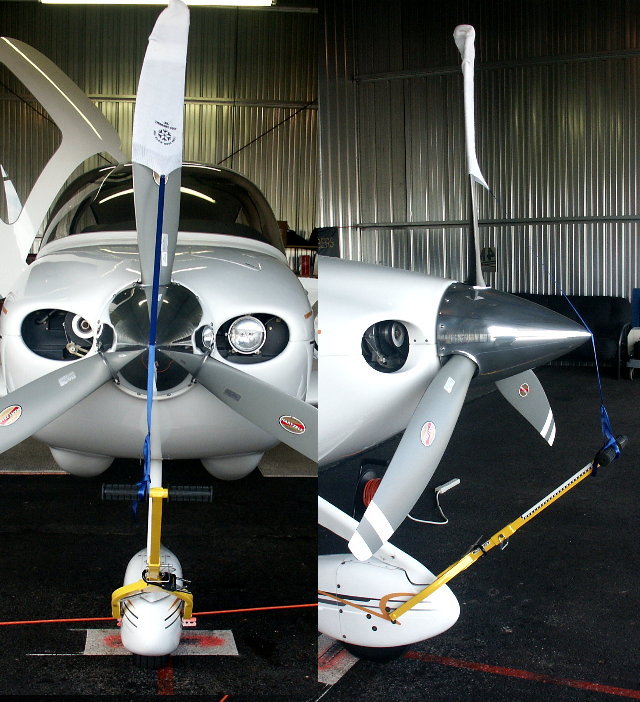
Mike,
Is that a plain old sock, or a custom-made Radomsky BladeBootie™? [;)]
Seriously, that’s yet another clever idea from your (uncountably) infinite bag of tricks.
Cheers,
Roger
Mike, I don’t have any problem with what you described (and was aware of it from your previous posts) - it’s casual use of the towbar that has the greatest potential for error - “I’m just gonna top the tanks off” etc.
Mike,
In reply to:
the ribbon is attached to a sock
Shame, shame, shame… You didn’t use a red sock embroidered with “Remove Before Flight” [:)]
In reply to:
You didn’t use a red sock embroidered with “Remove Before Flight” …
Marty,
I actually have one on order from Martha Stewart. The embroidery will be done using her new INSIDER stitching technique… [;)]
- M.
In reply to:
I actually have one on order from Martha Stewart. The embroidery will be done using her new INSIDER stitching technique…
The best thing about that model is that even if you do leave the towbar on, you can always swear that you took it off! [;)]
Marty
In reply to:
Your term, “a string of bad luck” is a polite term for “pilot error” - the first time by a qualified instructor, the second by myself, but I guess we all make mistakes - better on the ground than in the air!
Tim: You are far nicer than I am or at least have a lot more tact. [;)] Unfortunately, I usually call a spade a spade. If you’ve read many of my posts, you’d know that my mouth often leads me into trouble.
I am sorry for your ‘string of bad luck.’ And I do mean that (both the ‘sorry’ and ‘luck’ parts). Often the difference between a prop strike and life as usual is no more than serendipity. I am very concerned about the subject whenever on grass (with my Cirrus). I love operating off of grass, but the tightly faired wheels and the minimal prop clearance, have forced me to avoid ‘landing au natural’ as often as possible. I even worry about taxiing over uneven or degraded pavement.