Aria no longer sells them and don’t plan to due to a liability. No idea what it is, possibly due to one of the prior replies about window damage or window debone.
1 Like
Thank you for this!
1 Like
I’ve been thinking about a longer USBC cable so the batt is up front with me. My thought was then I could spot any battery issues quickly, even jettison the batt if needed (vs it being unreachable in the back).
My question is are the different kinds of USBC cables. I bought one recommended here but can’t recall if it had any specific features for this job, or what I works buy if say I wanted it to be like 6 or 10 feet…
1 Like
Have you tried opening the doors? Even in slow flight?
Has anyone?
I am not sure a jettison is in the cards… short of breaking the window.
My instructor popped a door in the pattern once as a training exercise, and once turbulence popped a door open on me.
But I’ve never tried opening it myself, especially wide. Worry trying I guess.
1 Like
I keep the battery close for the same reason, and test if it’s getting warm several times on longer flights, just a little paranoid I guess. I always thought if I slowed down significantly I would be able to open the door, and would happily break the window if it was between that and dealing with a runaway battery.
What’s very interesting about this is the juxtaposition between not being able to open the door very far in flight even when you try really hard, and the door being able to cause and inflight problem by accidentally popping open.
1 Like
To be clear, the door popped causes no inflight problems. It is the pilots potential reaction that causes problems.
To those that think they can open the door wide enough, give it a try. Bet you can’t. I am pretty sure you could break the window with enough effort. They are harder to break than you think. Probably fussing with the door or the window will take more time than you have with a runaway battery. Those happen scary fast. See this video and imagine that happening in your aircraft https://www.youtube.com/watch?v=8nz5ijXcckI
Don’t forget you have a horizontal stabilizer behind you that would be really likely for the battery to strike. Not sure how much damage that would do but a wheelpant bouncing off the runway hitting it makes quite a mess (I have a picture somewhere). And those are lighter and at lower landing speeds.
Just buy a safe chemistry battery if you are too cheap to put a dedicated circuit in the plane. I am frequently surprised by owners wealthy enough to have very expensive assets with the potential to kill and their unwillingness to do things right. Then they go pile their whole family in it. That observation is more broad than just batteries or StarLink.
2 Likes
Is not the door Dave, it’s thepilot who’s causing the problem 
The key is that it has a minimum of 100w capability. If you’re looking to run it neatly from a SL dish in the back window, around the trim paneling to the back seat and to around the center area near the cup holder or console, 14ft min is recommended. Here’s an example of a 15ft cable: Amazon.com: USB C to C Cable 15FT 100W 1Pack, Extra Long USB C Cable Fast Charging,USB C to USB C Cable Durable Braided, USB Type C Cord Compatible with iPhone 17/16/15/Pro Max/Plus/Samsung Galaxy S23/Switch/More : Electronics - many cables are 240w capable which will work fine too, the 100w is just the minimum.
I also recommend magnetic “L Connector” USB connectors (for the battery side). This keeps the cord from hanging straight out of the battery so it doesn’t get snagged or stepped on - and allows for a quick disconnect snapping the cable on/off for when you need to take the battery out for charging. If someone in the back does happen to snag the cord, it will just come off vs possibly bending/damaging the cord or USB port in your battery - super secure when attached though - highly recommend - Amazon.com: TRELC 240W USB C Magnetic Adapter 2 Pack, with 4 Connectors, Right Angle USB-C Male to Female Connector, USB4 40Gbps 8K 60Hz, Type C Extender for MacBook Pro/Air, Steam Deck, Tablet, Laptop : Electronics
1 Like
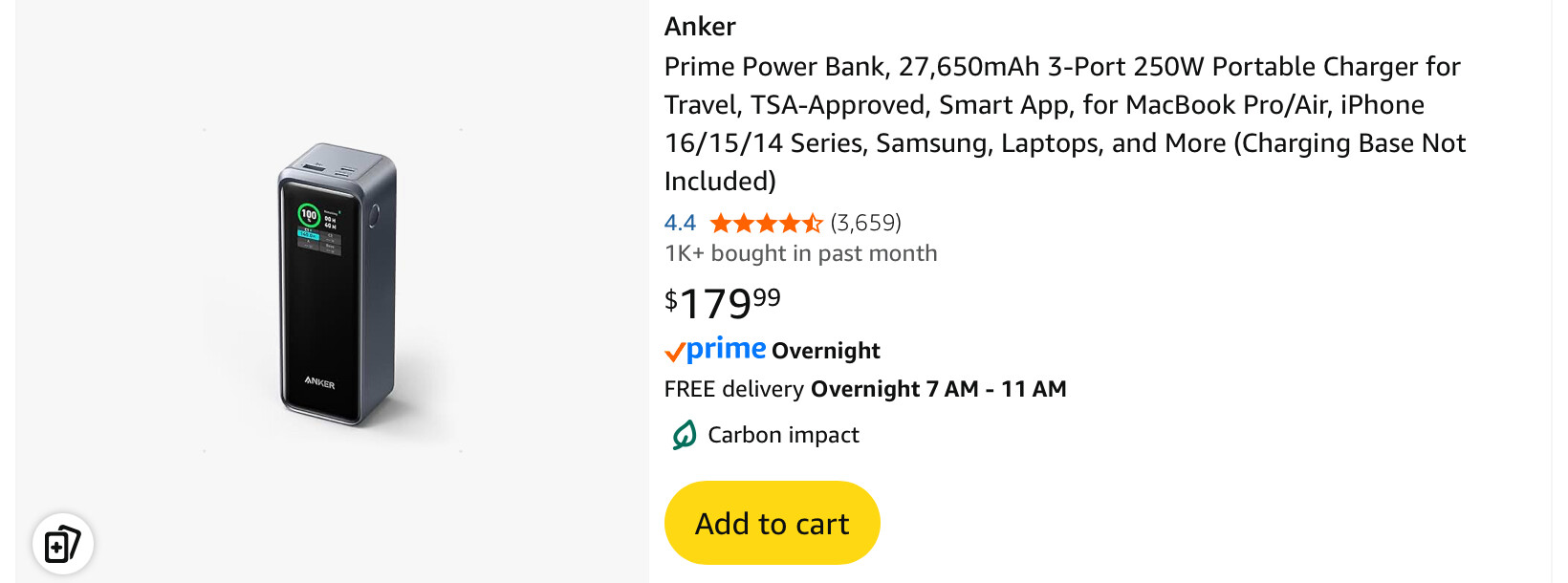
Is that this?
No…. A safe chemistry battery refers to LiFePO4 battery.
LiFePO4 Is typically a little larger, yet much more stable and capable of many more charge cycles.
Specifically check for LiFePO4 chemistry.
1 Like
They make no mention I could see about battery chemistry. Given that I would assume it is a standard Li cell battery. Always assume that unless they say otherwise.
If form and factor is privileged, the smallest would work.
I have the Solix C300 DC and works awesome with a lot of hours……

2 Likes
Not to mention if you do get the door open and you jettison the battery you have now sent a fiery bomb heading earthward. I can see all sorts of problems arising from that scenario. 
Better that than me and the whole plane!
Yes, I did know this. I’ve had mine pop open. It was no issue at all. I was trying to point out what a huge difference in perspective it is to have a door open by accident and surprise a pilot versus wanting to get the door open to throw something out.
2 Likes
Devil’s advocate here. I have an aversion to putting my plane in the shop and avoid it whenever I can. Some examples:
- I’ve had over a dozen EGT/CHT sensors replaced over the past 6 years. Just recently discovered I can buy a kit from Jim Barker and never have to deal with this again.
- I have water in my static system. My local avionics shop convinced me to replace my altimeter. The problem persists, and now my altimeter lights don’t work. I’m scheduling a visit to a CSC.
- Recently had my Avidyne MFD replaced. MFD works great, but one of my navigators no longer receives GPS signal. The shop (similar to item #2 above) forgot to hook it back up. I’m scheduling a visit to a CSC.
- Recently installed a SureFly. Worked great, but my CHT’s were exceptionally high. Shop was unable to fix, so I took to another shop and found it was timed incorrectly. Timing was adjusted and now my CHT’s are fine.
I consider all of the above to be minimally invasive tasks. Installation of a circuit and power outlet seems much more involved, and I would want a very qualified shop to perform the work. Every time I call a very qualified shop…the response is typically “We’re really busy, but will get you put on the list. Do you need it before the end of the year?” Truly, it’s the worst part of plane ownership.
If a portable LiFePO4 battery can solve my problem without being put in a shop’s “cue”…I’m in.
3 Likes
BTDT. One reason I got my A&P was to avoid those (I had some too). So you have my sympathy. You put in the right kind of battery so my post really does not apply to you. OTOH, you really should develop a relationship with a better class of mechanics. Good luck, that can be difficult.
Agreed. The mechanic who performs my annuals is incredibly good, but he’s in Booneville, AR. I’ve never had an issue with his work, and he is worth the trip for an annual. Unfortunately, he’s so good that he stays booked up and is halfway across the state from me. For now…a battery will have to do!
1 Like